Tuesday, June 14, 2016

Wes Washpun Vs. Isaiah Thomas NBA Draft Prospect Analysis Evaluation

Wes Washpun vs. Isaiah Thomas

Body Type Evaluation

Wes Washpun out of UNI is a hard guy to make a comparison to. At first, Kyrie Irving jumped out to me. However, Washpun being generously listed at 6’1” made that a hard comparison to make. While Isaiah clearly has the height disadvantage (standing at only 5’9”), they have similar physical traits. Both are ridiculous jumpers, with Washpun hitting 36.5 inches on the no-step vertical and Isaiah having what is rumored to be a 38.5 inch max vertical. Washpun is considerably longer than Thomas, being 3-4 inches taller and having a wingspan of nearly 6’7” (according to hoopshabit.com), almost five inches longer than Thomas’. Washpun, despite being the taller and longer of the two, weighs about ten pounds less than Thomas. However, both are similar in that they are undersized point guards with wingspans that exceed their heights by about 5 inches.


Statistical Evaluation

Statistically, this is another interesting argument. Metrically, they are very similar. Their rebound percentage, assist percentage, steal percentage, block percentage, turnover percentage and usage percentage for their last year in college all are within a few points of each other (Washpun having the lead in all of them except turnover percentage and steal percentage, and a lower usage percentage). Thomas has the lead in true shooting percentage by .014, as well as the lead in Win Shares and Box Plus/Minus (all stats courtesy of sports-reference.com). While Thomas seems to have been the more impactful player for his team, scoring and assisting at higher averages than Washpun, Wes appears to be the more well rounded player. He was seventh in the Missouri Valley Conference in blocked shots at 6’1”, and second in the conference in points produced. Thomas was also playing with three future NBA wing men, which may have aided in his assist numbers. Regardless, both were very capable college point guards, and they were both vital parts of their team's’ success. Washpun is a more well rounded player, while Thomas is a better passer and shooter.

Film Evaluation

When you go to the film, a few things become obvious. Both Washpun and Thomas are great penetrators and finishers around the rim, and they are both extremely bouncy and light on their feet. While, as I said, I initially compared Washpun to Kyrie, the fact that Washpun has to rely on quickness and explosiveness as opposed to Kyrie having his 6’4” frame backing him up makes it a harder comparison to make. Isaiah’s college mixtape shows a ton of jumping into passing lanes, driving and juking shot blockers, and passing from the interior. Washpun is versed in all three of these things, and while Thomas may shoot a few more threes, Washpun has the ability to expand his range (if you need proof, look up Washpun’s three quarter court jumper in UNI’s upset win over #1 North Carolina). While Thomas’s flashy interior lob and drop off passes are a thing of beauty, I was really impressed with Washpun’s ability to drive, turn into the post, and find an open shooter from the painted area like a Greg Monroe.


Final Thoughts

Wes Washpun is one of my favorite sleepers in this year’s draft. As I have said, I think he could very easily be a starting point guard in the NBA one day. He compares to Isaiah Thomas in many areas, including style of play and rebounding as a shorter player. Potential landing spots for Washpun could be places like Chicago, Memphis, Atlanta, or New York, teams that either need a point guard now or are preparing for the impending loss of their current point guard but also have other needs to fill earlier in the draft. For instance, I could see Chicago addressing their needs in the frontcourt first, then going after Washpun as the possible heir of Derrick Rose. Nonetheless, I think Wes Washpun has a tremendously high ceiling in the NBA, and should get the recognition he deserves.

Saturday, June 11, 2016

Henry Ellenson vs.Kevin Love Prospect Analysis and Evaluation

Henry Ellenson vs. Kevin Love

Body Type Evaluation

If you look at the measurables on both Love and Ellenson, it may seem pretty clear cut. Ellenson, the Marquette product, is listed on espn.com at 7’, 242 pounds. Love is listed at 6’10”, 251 pounds. Ellenson’s pre-draft standing reach and wingspan top Love’s pre-draft numbers by one and two inches, respectively. It looks as though Ellenson has the right body to be a center in the NBA on day one. However, according to Zach Brunner (@fantasyflurry has played basketball with Ellenson), Henry is probably closer to 6’10” (at only 19, nothing says he can’t reach 7’ at some point, but he will be quite undersized at the 5 on draft day). But, that doesn’t mean he and Love see eye to eye when it comes to height. Love’s 6’10” listing is one of the most controversial in the game, and he was measured at 6’ 7.8” without shoes at his NBA combine. Adding the average 1 ½” for basketball shoes, Love would have had to have grown nearly an inch since his combine to be a legitimate 6’10” in shoes. Ellenson fits the Kevin Love bill as far as being a slightly undersized rebounder with an offensive game that stretches out as far as anyone’s. But, I would say Ellenson has the edge on physical measurables, as he is now (at 19 years old) what Kevin Love has tried to grow into (and maybe never has, but nobody really knows).  


Statistical Evaluation

As far as the numbers go, these two are pretty close. Ellenson averaged 17 points, 9.7 rebounds, 1.8 assists and 1.5 blocks per game for Marquette (sports-reference.com). Love averaged 17.5 points, 10.6 rebounds and 1.9 assists per game for UCLA (basketball-reference.com). Just looking at that, you may be tempted to give Love the slight edge. However, teammates and competition have to also be considered (not to mention metric stats). Ellenson’s Marquette played against 12 NCAA tournament teams, and went 4-7 against those teams. Kevin Love’s UCLA team went 7-2 against ranked teams in 2007 (technically it was 7-1-V, after Memphis had their wins vacated due to some supposed shenanigans with Derrick Rose’s brother). However, Kevin Love played with three other future NBA players in his starting lineup (including Russell Westbrook). Ellenson’s right hand man (junior forward Luke Fischer) averaged 12.1 points, 6.2 boards and 1 assist (granted it was on a FG% of 60%, but still not even close to matching the impact of Russell Westbrook and Darren Collison). Love has the metric edge in pretty much every stat, but he was also quite a bit more free to shoot as he pleased with such impressive teammates. Ellenson has the potential to boost his rebounding to a Love-like level, but he needs to improve there if he wants to be equally as strong on the boards. I give the statistical edge to Love, but Ellenson had quite a bit bigger role on his team (and in turn more pressure on him to perform on a nightly basis).

Film Evaluation

When you go to the film, it’s clear that these two are similar players. They both are adept at using both hands on finishes in the post, and both have strong touch when putting up floaters. Love may appear to be a better and more willing passer, but just look at who he was passing to! Ellenson was tasked as a freshman to be the main contributor on a Marquette team that wasn’t stacked with talent, while Love was tasked to be ONE of the contributors on a #1 ranked team with multiple future NBA All-Stars on it.  While Ellenson may have seemed inconsistent with his jumper, just look at the following images.


Love has more space there than Ellenson would know what to do with (this is not the only time this happened, I just picked that play for an example). In addition to this, Love’s low post game was bolstered by the fact that defenders often fronted him to avoid being sealed on a drive by Westbrook or Collison (both accomplished drivers to the hoop). Don’t get me wrong, Kevin Love had an elite post game in college (and still does today). However, the numbers may be a little misleading.  Another thing that I have seen people knock Ellenson with is his defensive ability. While that is one of his weaknesses, I see things that tell me he will improve. For one, he really didn’t have any help on defense! When a player is driving on Ellenson, he was left to protect the rim on his own many times. It also seems like Ellenson has the physical, mental and emotional ability to work hard at improving his weak spots. For more on that, here is a quote from Zach Brunner: “That kid has his head on straight and has improved an insane amount from when I first met him when he was a freshman in high school. He has the work ethic to be the best, and that is his only goal right now. He has this slight arrogance that I think you need to succeed in this league. In his mind, if he wants to do something, nobody is going to stop him. Luckily, his head is on straight, comes from small town roots, and has that humbleness to back it up. Think like how Larry Bird was.” I’d say those are some pretty strong words.

Final Thoughts

I think Henry Ellenson is a very good prospect, and I would certainly take him in the top 15 in this year’s draft. Do I think he can be Kevin Love? Well, they are similar (but not identical) players. Ellenson has a better NBA body than Love, but his overall fundamentals are still lagging behind where Love was at his age. Ellenson is still adjusting to being a low post presence on both sides of the ball, as he tended to work more from the midrange area in high school. I’m very excited to see Ellenson in the NBA, and if he can continue to improve as a 19 year old player, he should be someone to watch for years to come.

Friday, June 3, 2016

Kris Dunn vs. John Wall NBA Draft Prospect Evaluation

Kris Dunn vs. John Wall

Body Type Evaluation

To begin this assessment, I am going to focus on one thing that makes both Wall and Dunn extraordinary from a measurements standpoint, (channeling my inner Jay Bilas here) their wingspan. An average NBA point guard has a wingspan of about 6’5” (nyloncalculus.com). Wall’s wingspan of 6’9” would have put him well over the 90th percentile. Now, according to espn.com, Kris Dunn out of Providence has a wingspan of 6’10”. We just saw how valuable a point guard who can shoot over defenders is when Shaun Livingston torched the Cleveland defense by penetrating and releasing over the shorter guard playing him. If Dunn’s wingspan is really that massive, that’s a big selling point for me. As far as standing reach goes, Wall’s 8’6” tops Dunn’s 8’4”, but 8’4” is still enough to put him close to the 90th percentile in that respect. From there, I can see why the comparisons are made. Both are slashing guards who have above average speed and athleticism, and both have had injury problems in the past (proving the while Dunn’s past injuries may be a red flag, the story can have a happy ending as it did with Wall’s success in the NBA). While the height and weight measurements on Dunn varies from listing to listing, most have him at nearly 6’4” and a little over 200lbs. Wall is approximately the same height, and just a little lighter at 196lbs. As far as this goes, I would say Wall and Dunn have very similar body types, which suit a very similar playing style. However, that certainly doesn’t paint the whole picture. If we want to fill in all of the blanks, and be able to make the most educated guess possible on Dunn’s potential, we need to look at this comparison from a few more angles.


Statistical Evaluation

Statistically, this is another interesting comparison. Both Wall and Dunn played with other dominant stars in college, Wall having played with guys like DeMarcus Cousins, Patrick Patterson and Eric Bledsoe, and Dunn with Ben Bentil (who is staying in the draft as of now) and Rodney Bullock. Wall and Dunn’s college scoring in the year before they were drafted (Wall was a one and done, so that was his freshman year) was separated by about a fifth of a point. Wall averaged 0.3 assists more per game that Dunn, but nearly a whole rebound less. Dunn also played less minutes per game than Wall, and therefore has better stats per 40 minutes. However, when it comes to Win Shares Per 40 Minutes, Wall has a considerable lead on Dunn (sports-reference.com), while concurrently having a lower usage percentage. Dunn has the lead in Player Efficiency Rating, which for the record I don’t like to rely on as a true judge of efficiency. Overall, the stats are pretty close. They both steal the ball at a very good clip, and they both are pretty prone to turnovers. In a purely statistical evaluation, I would have to give Wall the edge (also accounting for the fact that he was a freshman and Dunn has parts of four seasons played in college). But, while Ben Bentil was a great player for Providence, Wall had much better teammates (they had five players taken in the first round that year). Metrically, however, the edge probably goes to Dunn. He has a greater assist percentage, rebound percentage, steal percentage, and a lower turnover percentage (sports-reference.com). Shooting is a big topic for these two, as Wall’s shaky jump shot was often a question earlier in his career (he once shot less than 10% from long range in a year). Dunn’s three point shooting percentage his last year in college was better than Wall’s, but keep in mind that Dunn has had more time in college to work on it (he is only 3 years younger than Wall despite being in the draft six years after him). One thing about Dunn that has me worried is his rather low True Shooting Percentage. It sits at .541, which is lower than Wall’s college number. If Dunn is going to have a similar career arc as Wall, he will need to pick up his shooting as Wall did. From this perspective, it seems like Wall and Dunn share many of the same statistical strengths and weaknesses. But, there is one last test for them to go through, and that is perhaps the most important one of all for NBA scouts: the eye test.


Film Evaluation

Now, with the last two angles to this comparison, it’s pretty obvious how Kris Dunn drew his John Wall comparisons. But when it comes to the mixtapes, it goes beyond just a comparison. It gets to the point where it’s hard to tell them apart. I have watched both players, and I found John Wall’s college play a little more “dynamic”, but that doesn’t really matter much as far as production. Dunn has great speed, like Wall. He uses that speed and twitchy quickness to jump passes and get easy dunks, like Wall. He uses those easy dunks to create future openings when it comes to penetration, like Wall. In fact, I re-watched a few mixtapes of Wall and Dunn from college, and I was a little bit frightened by the similarities. If you get a chance, find Wall’s game winner vs. Miami (Ohio) on YouTube, then find Dunn’s game winner vs. Creighton. It’s the same play. Dunn goes the same way as Wall, he steps back in the same spot, shoots pretty much the same shot, and it ends with the same result. Wall’s was a splash, it barely touched the net. Dunn’s hit the back of the rim, and bounced around a while before going down. Regardless of how it went in, it did on both occasions, and ended with a win being put in the column of Kentucky and Providence.


Final Thoughts

John Wall is a tremendous player. Kris Dunn is a tremendous prospect. Will their career parabolas share the same arc? I don’t know the answer to that question, nobody does right now. However, what I can say is that Dunn shares many of the traits of a player like Wall. While Wall did what he did as a freshman, and therefore seemed to have more potential, Dunn is still someone I certainly would take in the Lottery. Without doubt, I can say that Kris Dunn is the real deal, and could fill a similar role as Emmanuel Mudiay did last season. But, comparing those two is another story entirely, one that I don’t choose to tell. I conclude this article by saying the following to any NBA team who thinks they can contend with a combo guard who can step in and competently score and defend in a number of ways- Kris Dunn is available, and ready to go.

Monday, March 28, 2016

UVA vs. Syracuse

With all the talk about this game, I thought I would weigh in before us sports fans have something else big to talk about. With all the talk about the possibility of fixing games, questionable calls (see photo below) and late game collapses, nobody seems to be talking about a brutal mistake that may have cost UVA the game that was NOT made by a player or referee. Many people refuse to believe that Tony Bennett failed to coach his way around a surging Syracuse team (for the record, 'Cuse is a great team that deserved to be in the tournament) and was a main cause of UVA's demise. If you look at the numbers, the glue that held UVA together was senior center Mike Tobey (who SHOULD hold a future in the NBA, if GMs had any sense). However, Tony Bennett played Big Mike sparingly in times when he should have been featured in a starring role. Tobey had 10 points, 4 boards, 1 highlight reel assist and multiple blocked shots in only 18 minutes of action in his final game. If you look at the games when Tobey got real minutes, a pattern starts to emerge. 26 minutes against Georgia Tech netted a final line of 7 points and 7 boards. 20 minutes against Clemson? 6 points, 6 rebounds, 2 blocks and 2 steals. 25 minutes on senior day against Louisville? 15 points and a whopping 20 boards. Tobey was also averaging 11.5 points, 4.8 rebounds and 1.3 blocks in the NCAA Tournament while playing only 15.5 minutes per game. Now, one would think that a 7ft powerhouse on a hot streak would be playing crunch time minutes against a Syracuse team that lost it's best rebounder to foul trouble. However, Bennett saw that 'Cuse center Tyler Lydon had a good shooting touch and decided that they would sacrifice post dominance for a slightly better perimeter defender and benched Tobey. That, in part, cost them the game. Tony Bennett is a tremendous coach, and is partly responsible for getting Tobey on this streak in the first place. However, I am now hypothesizing that Bennett has "frozen up" during the tournament and has caused his team to make repeated early exits as 1 or 2 seeds. For instance, he couldn't adjust his team's defensive strategy to Travis Trice's hot shooting for Michigan State in a previous tourney, which caused a bracket busting early loss for his team.  I can't put the blame on Bennett alone, a team is usually the main force behind it's own collapse. However, multiple mistakes were, in my opinion, made by Coach Bennett that in a way "helped his team down". Another one of those mistakes was not making sure that London Perrantes, who had made 5 consecutive long bombs at one point in the game, took the final three. As we all know, he did not, and the game was left up to a far less consistent shooter.

Food for thought- Mike Tobey averages 18.7 points, 11.1 rebounds, 1.5 blocks and 1.7 turnovers per 40 minutes, per sports-reference.com. Considered one of the best big men in the NCAA, Notre Dame's Zach Auguste averages 18.9 points, 14.5 rebounds, 1.5 blocks and 3.3 turnovers per 40 minutes. NBA prospect Kaleb Tarczewski out of Arizona averages 13.7 points, 13.6 rebounds, 2.0 blocks and 1.9 turnovers per 40 minutes. Cal star center Ivan Rabb averages 17.5 points, 11.9 rebounds, 1.7 blocks and 2.1 turnovers per 40 minutes. I just compared Mike Tobey's numbers to the numbers of three NCAA bigs that are considered elite, and he seems to fit in quite nicely.


Virginia's Mike Tobey (10) shoots against Syracuse's Tyler Lydon (20) and DaJuan Coleman (32) during the second half of a college basketball game in the regional finals of the NCAA Tournament, Sunday, March 27, 2016, in Chicago. (AP Photo/Nam Y. Huh)
Courtesy of AP and NewsOK


Monday, March 14, 2016

NBA G.O.A.T. List

It's one of the most debated questions out there. Who is the greatest player in NBA history? It isn't one that is easily answered. However, I have attempted to make a list using only a collection of stats. Without further fanfare, here it is: *some stats estimated

1. Wilt Chamberlain*

2. Julius Erving

3. Michael Jordan

4. LeBron James

5. Hakeem Olajuwon

6. Kareem Abdul-Jabbar

7. Vince Carter

8. Jason Kidd

9. Tracy McGrady

10. Karl Malone

11. Kevin Garnett

12. Allen Iverson

13. Antwan Jamison

14. Spencer Haywood

15. Tim Duncan

16. Charles Barkley

17. Dirk Nowitzki

18. Mitch Richmond

19. Shaquille O'Neal

20. Kobe Bryant

21. World B. Free

22. Magic Johnson

23. Reggie Miller

24. Alex English

25. George Gervin


That was just the top 25. Normally, these lists are very opinionated. However, this one is entirely stat based and also takes into account the talent of teammates in each candidate's best season or two. I have added a few players that usually wouldn't be considered for a list like this just for reference, I'm sure you can find them. Have questions, comments, anything you want to say, just toss it in the comment section or hit me up on Twitter at @hoover__26!

March Madness 2016 Breakdown

2016 March Madness Breakdown

March Madness is finally here! The zenith of the fantasy sports year (at least for me), this year’s March Madness is primed to be one of the maddest on record. This article will break down some of the tougher (or more exciting) matchups in the first and possibly second round. Have your bracket ready? Good! Now, let’s begin!

1 Kansas vs. 16 Austin Peay, Round of 64

Kansas is going to win. Let me say that right off the bat. You may be thinking, I thought he was going to be breaking down the tougher to decide matchups. Well, I started with this one because Austin Peay is going to give Kansas a fight (and make this one of the most watchable 1/16 games in the tourney). Chris Horton is averaging 18.9 points and 12 boards per game for the Governors, and Josh Robinson is averaging nearly 17 points to go along with his 80+ FT%. This should be an awesome game, and if any #1 seed is going down this year (I’m 99% sure they won’t) it might be Final Four favorite Kansas (but probably not). If Kansas can make it past this game (which they will, in all likelihood) it may seem that a matchup with the Cal Golden Bears is the only legitimate challenge for them until the Final Four. But wait a minute, what if Cal never goes that far (they wouldn’t meet until the Sweet Sixteen)?

4 California vs. 13 Hawaii, Round of 64

This one may seem like an easy choice on the surface. Cal has a bunch of future NBA players on their roster, and Hawaii is 0-1 vs. Top 25 teams (yahoo.com). However, the Rainbow Warriors (yes, the Rainbow Warriors) are a much tougher team than you may think. Hawaii’s points scored vs points allowed differential is better than that of Cal, and they out-assist Cal by 2.8 dimes per game. Understand, however, that Hawaii’s numbers came against less talented teams. That is a detracting factor, as Hawaii would be the favorite if their stats came against the same opponents as Cal. Nevertheless, Hawaii is one of the better teams in the nation defending the perimeter, and also have stud post player Stefan Jankovic averaging 1.2 blocks per game. Hawaii is also much deeper than Cal, having eight players scoring over 5 points per game (compared to just the starting five for Cal). If you want to be contrarian with your picks, Hawaii is one of my favorite first round upset choices against a slow, methodical Cal team.

7 Iowa vs. 10 Temple, Round of 64

First off, Iowa has only two players that average double digit scoring. That may seem like a disadvantage, and it usually is, but take into consideration that those two guys are Jarrod Uthoff and Peter Jok. Uthoff has an elite stat line of 18.9 PPG, 6.4 RPG and 2.7 BPG, as well as a .392 percentage from long range.  Jok is a top-notch shooter, and is second on the team in scoring and steals while averaging only about 27 minutes per game. Temple has their share of star power, with do-it-all player Quenton DeCosey leading the team in scoring. They also have elite rebounder Jaylen Bond, who will help them on the glass against a solid rebounding team in Iowa. This is one of the closer matchups, but I would have to say that Iowa has the edge here. I just don’t think Temple, who sits at 271st in the nation in scoring, can keep Iowa from out-shooting them. I know that jump shooting teams are usually frowned upon in the tourney, but Iowa is more than just a one trick pony.

8 St. Joseph’s vs. 9 Cincinnati, Round of 64

This one is a bit odd, as the higher seed in St. Joe’s is actually losing the “popular vote”, so to speak, 48% to 52%. That is more than likely because of the Bearcats’ stifling defense (fun fact, the Bearcats are NOT named after the animal, which is actually called a Binturong, or the Stutz Bearcat, but after former Cincy fullback Leonard Baehr). Cincy also has a star guard in Troy Caupain, who dropped 37 points in the team’s quadruple overtime loss to UConn. However, St. Joe's has a stud guard of their own (as well as Timmy Parks, who currently suits up as the most awesome mascot in sports, the St. Joseph’s Hawk). DeAndre Bembry is one of the most consistent players in all of basketball, having scored in single digits only once in the entire season. He also leads the team in assists and steals, and is second in scoring and rebounding. The team’s scoring and rebounding leader is Isaiah Miles (who also led the Philadelphia Inquirer’s all-improved team), a 6’8” forward who has also drained 62 treys at a 38.8% clip this season. Cincy may be a little deeper than St. Joe’s, but the Hawks may have found a new threat in forward Papa Ndau. In all, Cincy’s tough defense and electrifying guard play will be a formidable task for the Hawks, but I feel that St. Joe’s consistency will win out in the end.

6 Texas vs. 11 Northern Iowa, Round of 64

This one was a puzzler. I stared at the numbers for what seemed like forever, took into consideration everything I knew about both of these teams (which is probably more for Texas than UNI, as I followed Shaka Smart intently), and I still had trouble coming up with a conclusion. First, let’s revisit the numbers. The first thing that jumps off the page is UNI’s lack of depth. It isn’t that they don’t have a lot of good players,because they do, but the fact is they only have ten players all together who actually play. UNI’s top gun, Wes Washpun, is putting up a very strong 14.3 points, 4 rebounds and 5.2 assists per game. They don’t have anyone with outstanding rebound numbers, but they have a bunch of players with pretty solid totals (they are still low on the rebounding list). The same pretty much goes for Texas, as Cameron Ridley (whom I forsee getting around 15 minutes in their game) is the only Longhorn averaging more than 5.3 boards per game. Texas is bigger, but UNI is a far better shooting team. UNI also has taller guards, which I have found leads to deeper tournament runs in some cases. It seems like there teams could cancel each other out. Next, I look to the points scored/points allowed differential, and I find that UNI is winning that category. Lastly, I see that UNI is coming off a 6 game winning streak (including a win over possible 11 seed Wichita State), while Texas lost their last game against Baylor, as well as two losses in their last three games (the one win came against a non-tourney team in Oklahoma State). As much as I love Shaka Smart’s coaching style (it isn’t Havoc anymore, but it’s close), I am feeling UNI by a nose here. But I don’t think this could be any closer.

8 USC vs. 9 Providence, Round of 64

One thing I usually don’t like to use in the tournament, as it corrupts your perception of statistics, is the eye test. However, IF we were going on the eye test, this wouldn’t even be a question. Ben Bentil and Kris Dunn can only be described with one word, that word being “WOW”. USC has had a history of giving up big games to strong centers, so Bentil should come close to his 20+ points per game average. Dunn is so athletic, I don’t know if Julian Jacobs can run with him. USC is no pushover, though. They are in the top 20 in the nation in scoring, and grab nearly 40 rebounds per game. However, they give up about 75 points per game, which is especially bad when you play a team that has multiple 90+ point performances. In my opinion, Providence takes this one. However, I don’t think they have a huge chance of beating North Carolina in the round of 32 (assuming UNC beats either Florida Gulf Coast or Fairleigh Dickinson, probably Fairleigh if I were to pick that First 4 game).

7 Wisconsin vs. 10 Pittsburgh, Round of 64

The classic battle of the big name school vs. the low expectation cinderella. Wisconsin went to the big game last season, but lost a boatload of players. Pitt is an elite passing team, with some very physical players to match up with Wisconsin’s Nigel Hayes (16.3 PPG and 5.8 RPG). A main issue for Pitt is their lack of shooting, as no Panther made more than 46 threes (Jamel Artis). Wisconsin's Bronson Koenig, a 39.4% shooter from long range, made more threes than Pitt’s second and third best shooters combined. Wisconsin has a few players that rely on post scoring and rebounding, but Pitt and 6’9” forward-center Michael Young have held guys like Brice Johnson to only 7 boards. Personally, I think Wisconsin is getting a little too much credit for what they did last year. Pitt looks to me like a team primed for an upset, and could set you apart from your fellow bracket makers.

7 Dayton vs. 10 Syracuse, Round of 64

Now, Dayton has given me some huge boosts in the past when they made surprising runs (well, not too surprising to me). However, I think the Dayton magic has run out. They looked out of sorts in their last few games, and could be in a position to lose to a team many thought should have been NIT bound. Michael Gbinije is a star for Syracuse, and if Trevor Cooney can find his shot again, they could be a dangerous team. I contacted a team manager on Syracuse who hinted that he expects Syracuse to pull this one out (which isn’t all that surprising, seeing as he IS a team manager for them), and I agree with him. The ‘Cuse is loose!

Wednesday, February 3, 2016

NBA- Who Replaces San Antonio's Big 3?

NBA Dynasty- Who Replaces San Antonio’s Big 3?


The San Antonio Spurs are one of the NBA’s premier teams, and have been for over a decade. This is due, in large part, to their Big 3: Tim Duncan, Manu Ginobili and Tony Parker, who are accounting for 72.5 espn.com fantasy points per game this season. However, the Spurs’ Big 3 have a combined age of 110. Timmy is having some serious knee issues, and Tony has struggled to put up numbers on a consistent basis this year. Manu may not be sitting out games for rest, despite being 38 years old, but he hasn’t been seeing as many minutes in the first place. Fortunately for the Spurs, they have a franchise that is stacked with young talent. Talent that will be stepping into some big shoes once the Big 3 either retires or starts to see Kevin Garnett-esque minutes. In this article, I will outline the players that you NBA dynasty players should be targeting now from the San Antonio Spurs bench and D-League.


Ray McCallum, PG, 9.9 MPG


While he isn’t exactly the heir apparent to Tony Parker (Patty Mills appears to be next in line for the throne), he should still see a spike in minutes when Parker’s role regresses. Patty has only seen enough minutes to be fantasy viable when Parker is injured, but I suspect McCallum should see plenty of court time when Patty is starting. The drop-off from Parker to Patty was considerably larger than the drop-off from Patty to McCallum, so the minutes will be more than likely closer to a split. The issue with McCallum is, we have really no idea what he can do in the long term. He went to the University of Detroit Mercy, which hasn’t been to the NCAA tournament since 2012 (when McCallum was playing), and is coached by McCallum’s father. He averaged 18.7 PPG his senior year in college, and hasn’t made more than 30 starts in any of his three NBA seasons. He did hit the 30 mark last year with Sacramento,  but ended up averaging only 7.4 points and 2.8 assists per game. That could have something to do with the fact that he was playing with DeMarcus Cousins, who was averaging over 18 shots per game. When he gets his chance in San Antonio, he will be more developed, and playing alongside Kawhi Leonard who is far more selfless. I would target McCallum in deeper dynasty leagues, as he will be taking a good portion of the minutes when Tony Parker is no longer holding the reins.


Kyle Anderson, SF, 12.5 MPG


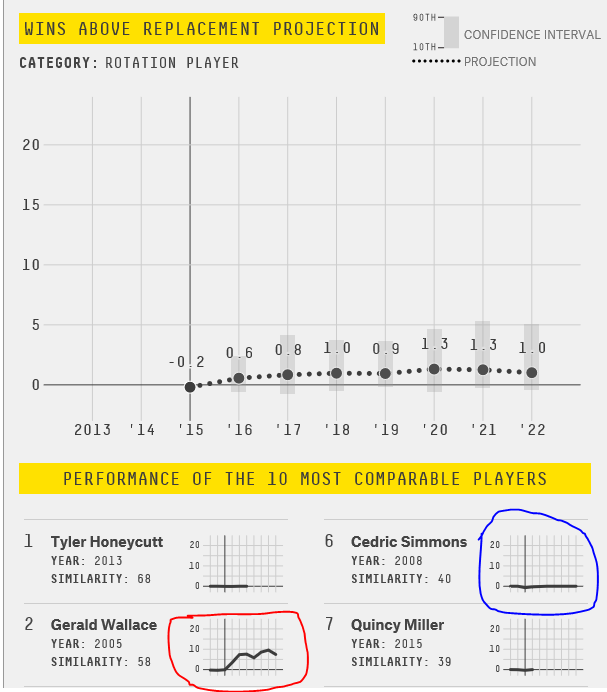
Kyle Anderson is an interesting player. He has played his entire 2 year career with the Spurs, but hasn’t cracked the permanent rotation yet. His days at UCLA really are the only thing we have to go on as far as future production goes. He was a Swiss Army Knife to be sure, averaging 14.6 points, 8.8 boards and 6.5 assists per game in his second and final year of college. Anderson is a great target in dynasty leagues because with all the minutes that are going to be opening up, Anderson can fill multiple holes. At 6’9”, 230lbs, Anderson could conceivably play all five spots on the floor. His natural range would be the 2-3-4, but his passing skills could allow him to play “point forward” and take the ball in. His rebounding ability could also make him a valuable small-ball 5, not unlike Draymond Green. One of my favorite resources, FiveThirtyEight’s CARMELO career projection of Kyle Anderson isn’t exactly fantastic. However, this may not be accounting for the fact that Anderson might be primed to take over the Big 3’s lost minutes. Take a look at Anderson’s projected WAR, but keep an eye on the
similarity scores. We just have to hope that Anderson’s career line ends up more like the one I circled in red than the one in blue.


This just shows how little we really know about how good he could be. But, what I do know is that he is versatile as can be. That will really give him a big boost in the race to claim the legendary minutes that are about to be forfeited, as he can step in to fill any need his team has. Anderson is someone I would be targeting in dynasty, purely do to his huge upside.


Boban Marjanovic, C, 8.4 MPG


Boban is one of my favorite young players in the NBA. He is a huge, humongous, hulking center, standing at 7’3” and weighing in at 290lbs. His hands are supposedly bigger than Kawhi Leonard’s (Leonard’s hands measure 9.75”, which is huge), and he has a wingspan of 7’8”. He is a ridiculously ginormous man. He can also play some basketball, which is sometimes hidden by his giant stature and limited minutes. If you expand Boban’s stats so they are per 100 possessions, he averages 34.9 points and 21.2 rebounds with a ridiculous 128 Offensive Rating (basketball-reference.com). Consider the fact that “The Admiral” David Robinson’s best season for that stat was 1996-97, where he averaged 39.6 points and 19.1 rebounds with a 117 Offensive Rating per 100 possessions. Boban is starting to look pretty good, huh? I understand that Boban is mostly playing against second units, but by the time Timmy is retired and LaMarcus Aldridge is in his 10th or 11th year, Boban will be ready to jump in and play some big minutes. I’m not expecting David Robinson out of him by any stretch, but I would be surprised if he didn’t put up really good fantasy stats when his number is called.


Jonathon Simmons, SG, 13.9 MPG


With Manu Ginobili nearing the end of his storied career, San Antonio needs someone to step up and fill that gaping hole. Simmons stands at 6’6”, the same height as Ginobili, but he has more athleticism than three of Ginobili. Simmons has the ability to play above the rim, which could be a useful skill as the Spurs transition from fundamentalists to a more modern system. Simmons also has a very nice touch from long range, shooting nearly 43% from deep. The thing that Simmons really needs is a midrange game. He attempts over 70% of his shots from either within 3 feet of the hoop or from behind the arc. If anyone can turn Simmons into a more well rounded player, it’s Gregg Popovich. Simmons has tremendous upside at only 26 years old, and could be leaping into a big role with the high number of minutes that are about to be unclaimed.


Cady Lalanne, C, 25.8 MPH (D-League)


Lalanne has never played in the NBA, but if the college and the D-League is any indication, he should be pretty good. He averaged 11.6 points and 9.5 boards per game his senior year at UMass, and is averaging 12.3 points and 7.7 rebounds in 27 Austin Spurs games this season. When the young man finally gets his chance, he will have probably learned to use his 6’10” 250lb frame (with a 7’5” wingspan) to his advantage significantly more. For someone who has already come close to averaging a double-double, that could spell doom for anyone trying to box him out. He also needs to work on his passing, which is something he didn’t really have to do in college. However, as I said before, Pop (the master of ball sharing) can do something to change that. If you are a dynasty league player looking for someone who could get you great rebounding and block numbers (and you can’t get or already have Boban), I really like Lalanne. He is a raw talent to be sure, but if any team can shape him into a star, it’s San Antonio.